ARCANE RADAR for ARC Raiders is worth buying if you want to see the whole raid but refuse to hand your crosshair over to software. This is an external radar and ESP overlay with no aimbot: it draws players, ARC robots, loot, containers and extraction points, but it never snaps, never fires and never touches your mouse. Pricing starts at $4 for three days, a month costs $35. The product page in our catalog: ARCANE RADAR.
One warning first, so nobody wastes money. At the time this review went up the build is on update (status on_update), and sales resume once the developer Arcane confirms compatibility. We are not calling it undetected right now: the live status sits on the product page and flips the same day a new version lands.
We tested it before it went on update. We looked at overlay readability on Buried City and Stella Montis, the behavior of the loot tables, how routing works, and how all of it holds up under foggy map conditions. The anticheat here, as a reminder, is kernel-level EasyAntiCheat, and Embark runs machine learning models on player telemetry on top of it.
How we tested ARCANE RADAR
The run took several evenings and split into four scenarios. Solo lobbies on Dam Battlegrounds were the baseline: that is where you find out whether the overlay reads well at all when nothing is happening. Buried City was the opposite case, with multi level construction, tight corridors and floors stacked on top of each other, which is exactly where a radar either handles verticality or falls apart. Stella Montis we ran for marker density, since the map holds roughly seven hundred and twenty of them and any ESP risks turning into soup there. Separately we chased night and fog from the Map Conditions system, which since Live Update 1.42.0 on 18 August 2026 runs on a regional schedule instead of a global one.
We watched specific things: whether the overlay keeps up with positions during fast movement, whether the drawn distance matches the real one, whether container information goes stale after someone else cracks them open, and how often the Route button lands on walkable geometry. There is no aimbot here, so the block about smoothing and FOV that usually fills our reviews simply has nothing to describe this time.
Why ARCANE RADAR has no aimbot and why that is the main argument
The missing auto aim looks like a downgrade until you look at what actually gets people caught in ARC Raiders. In its official Ensuring Fair Play material, Embark names input telemetry analysis as one of its most effective detection methods and mentions a partnership with a company called Anybrain. So the defense reads more than process memory, it also reads the way you move your mouse and how fast you react when a target appears on screen.
The math after that is simple. An aimbot, however smoothed, leaves a trace in the input profile: the pull onto target is too even, reaction timing too consistent, the natural micro tremor of a hand disappears. A radar without an aimbot adds nothing to that profile. A living person still shoots, the same person still moves the crosshair, and the mouse acceleration curve stays yours. The software supplies information, while the decision and the execution stay with the player.
That is the point of the purchase. You get an edge in knowledge rather than in mechanics: you know where the enemy is, how many there are, what they carry and what sits in the crate behind the wall, but you still learn to hit shots yourself. For players spooked by the three step ban ladder and the false ban wave, that trade usually settles the question.
The false ban story is telling on its own. After one anticheat update, bans started hitting people with unusual peripherals, pedals and rare controllers among them, the false ban investigating thread in the official Discord collected hundreds of posts, streamer Tfue got caught in it, and appeals came back with a flat "ban upheld". Embark replied that a real person reads every appeal. The practical takeaway for us: the system judges partly by what your input looks like, and the less you interfere with that input programmatically, the fewer reasons there are for a disputed case.
ARCANE RADAR features tested in practice
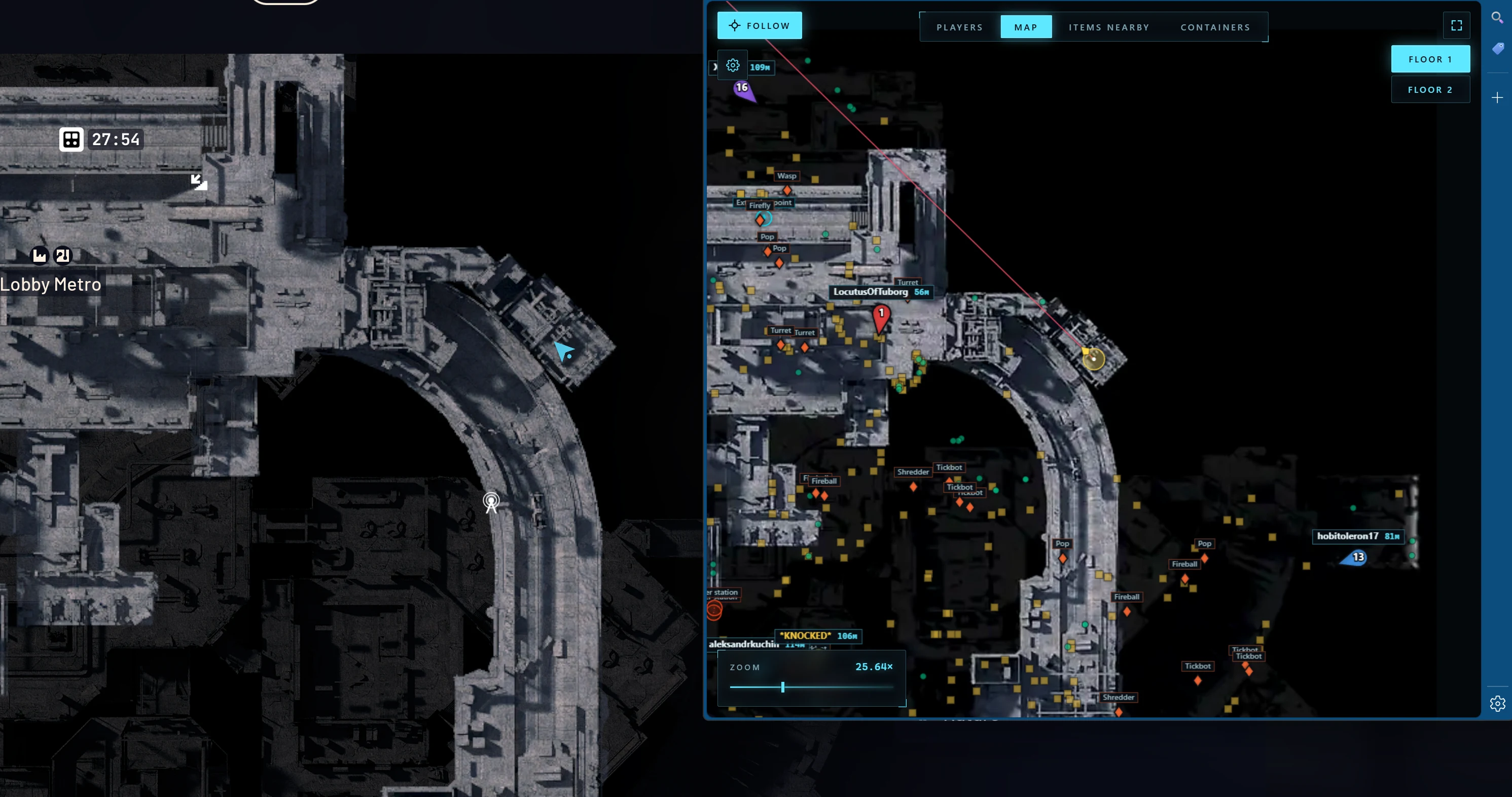
Everything splits into drawing layers and summary tables. Layers cover what you see over the world, tables cover what you can sort and click, and each one gets its own section after the table.
| Layer | What it shows | Where it pays off |
|---|---|---|
| Players | Name, distance, weapon in hands, line to target, squad number and color | Approaching the hatch, fights inside buildings |
| ARC robots | Type name and distance | Picking a route around a patrol |
| Items | Name, distance, filter by loot category | Targeted blueprint farming |
| Containers | Type, distance, open or closed status | Locations somebody already swept |
| Objects | Extraction, supply stations, generators, probes, mines, quest items | Planning the way out of a raid |
Player ESP: name, distance and weapon in hands
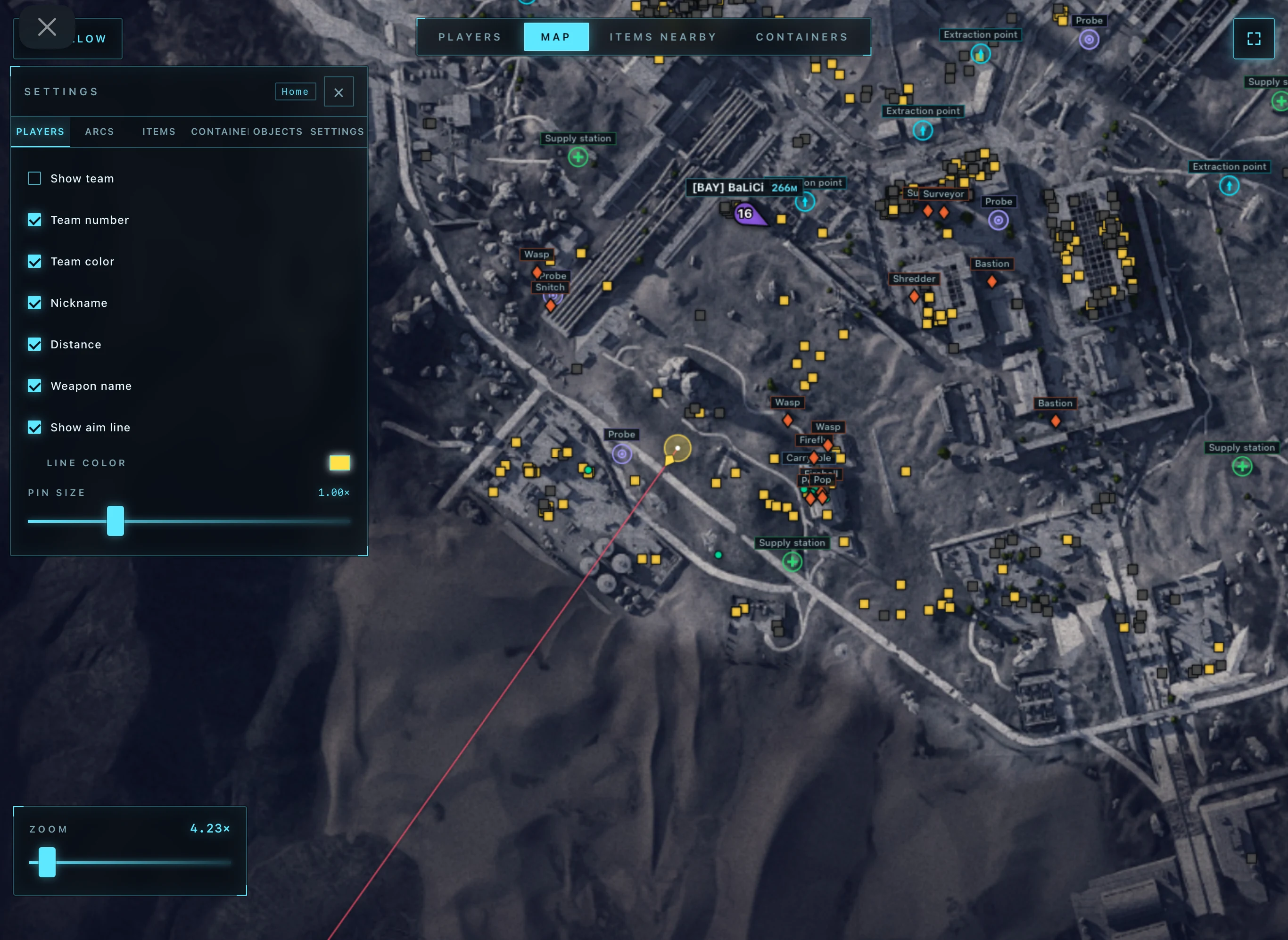
The main layer draws a name, a distance in meters, the weapon a raider is holding right now, and a line to target through walls. Squad marking works separately: a team gets its own color and a team number, so three markers in one stairwell read instantly as one squad rather than three unrelated solos.
Weapon in hands turned out more useful than expected. Engagement range decides almost everything in ARC Raiders, and a shotgun marker at a building entrance means one thing while a long barrel on a rooftop two hundred meters out means another. In the first case you stay out of the corridor, in the second you simply keep out of sight and finish your business.
Squad marking pairs unexpectedly well with proximity voice. ARC Raiders keeps proximity chat on by default, so you hear an enemy team talking before you see anyone. Guessing their headcount by ear used to be part of the job. With team numbers on the markers the question closes in a second: two voices and two markers sharing a number mean a duo, not scattered solos, and you plan the talk or the fight accordingly.
The line to target helps with verticality. Buried City is built so that an enemy can sit directly above you through two floors, and without a visual vector that reads poorly. Here the direction is visible, and it is clear whether to take the stairs or step outside.
ARC robots on a separate layer: where not to walk
For machine enemies the overlay gives a type name and a distance. It sounds modest, yet this is what saves a raid most often. The difference between a Tick, which travels in packs and makes plenty of noise, and a Matriarch, which you simply will not kill solo, comes down to whether you learned about her forty meters out or point blank.
We treated the ARC layer as a routing tool rather than a target list. A Wasp hovers over the yard, a Rocketeer shells the area from range, so the yard gets bypassed through interior rooms. There is a side effect too: gunfire against robots pulls live players in, and knowing where ARC are being shot right now tells you where somebody else's team will be a minute later.
Loot and the category filter
The item layer shows a name and a distance, and the filter lets you switch off everything except the categories you care about. Without a filter, a dense map like Stella Montis floods the screen with text fast, while two or three enabled categories bring the picture back to something usable.
The practical value comes from spawn randomization. The same house in ARC Raiders hands you a full backpack one run and nothing the next, so clearing buildings in order turns into a lottery with your time as the stake. With item ESP you see in advance whether anything from your list is inside, and you walk past when it is not. The blueprint list in the game has passed seventy entries, some of them sitting only in specific locked rooms, so a targeted search saves far more than it looks.
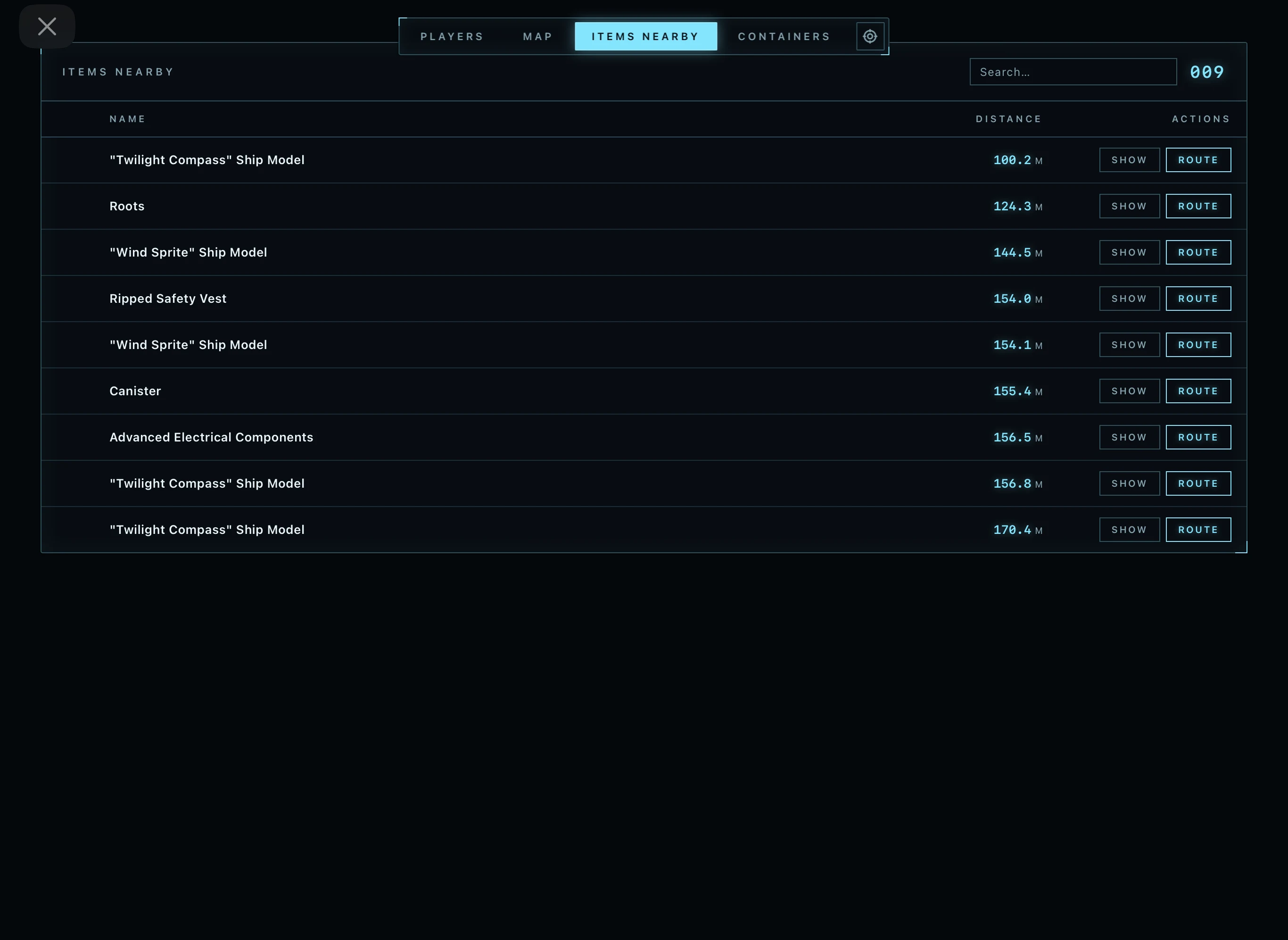
Containers with open or closed status
Crates get their own drawing, and here sits a detail half the competition lacks: next to container type and distance you see whether it has already been cracked. A filter by crate type is there as well.
The value shows up two minutes after landing. If somebody swept the location before you, untouched markers cluster in one wing while emptied ones trail along a stranger's path. You skip the pointless lap and you also learn where the person who was here went. On The Blue Gate with its locked rooms it further tells you whether a key is worth spending.
Map objects: extraction, supplies and mines
The object layer covers everything else that sits statically on the map. The list includes extraction points, supply stations, generators, probes, mines and quest items.
The hatch is the pressure point of this game: people lose a full backpack there more often than in the open field. Seeing in advance which extraction is closer, and approaching it on an arc rather than a straight line, cuts the odds of walking into an ambush by itself. Mines deserve their own mention for pace: people step on them in a hurry all the time, and on the overlay they show up earlier than underfoot.
Player, item and container tables: the Show and Route buttons
This part of ARCANE RADAR is the best built one, and it is the reason the build sits in our catalog. Besides drawing in space, the software keeps three summary tables.
- The player table gathers every detected enemy into one list: team number, name, weapon, health and distance in a single row. Sorting by distance turns it into a threat panel where the top line decides the next thirty seconds.
- The nearby items table shows everything lying within radius instead of labels scattered across the screen.
- The nearby containers table works the same way for crates, with the opened status attached.
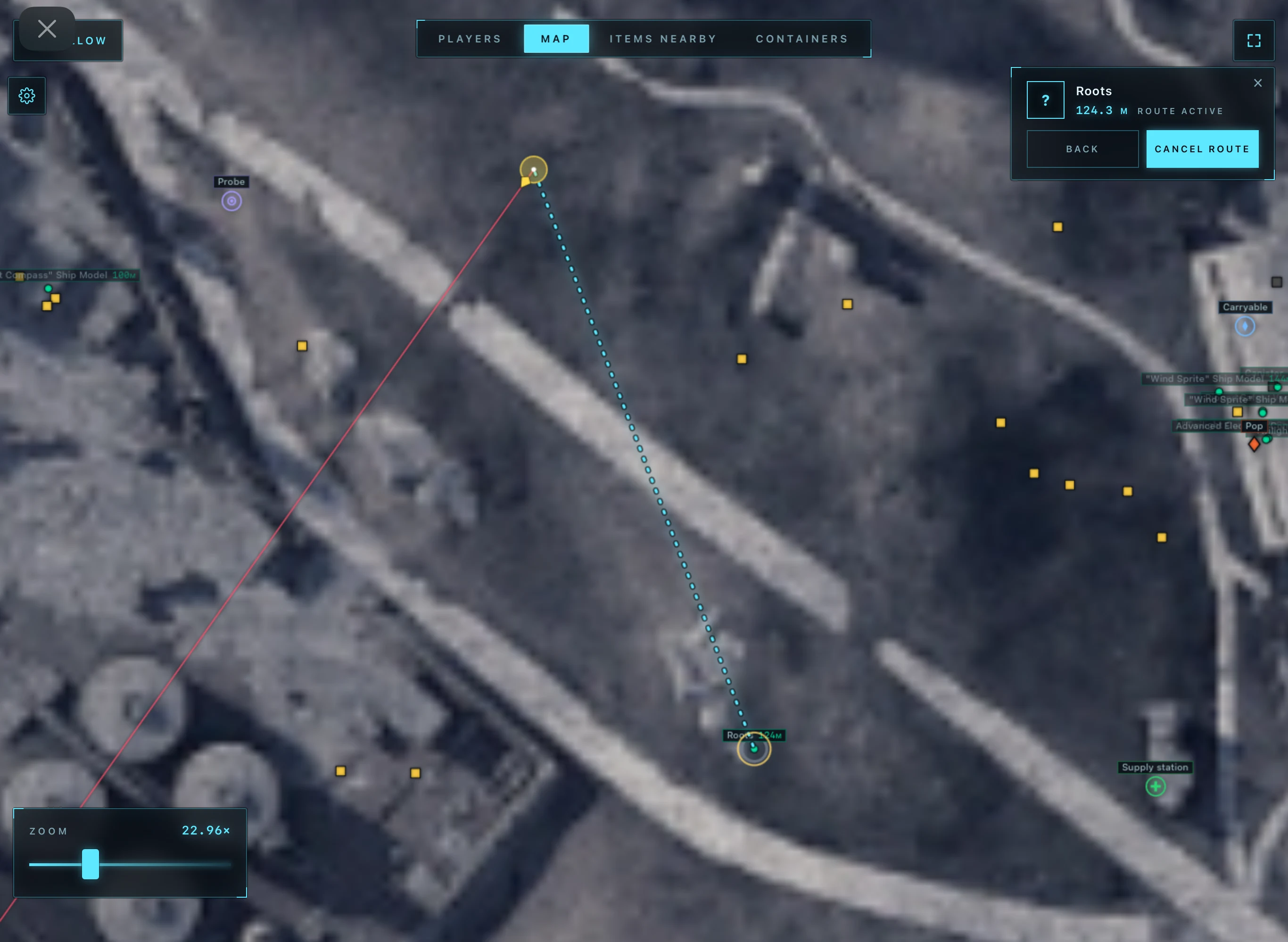
- The Show button highlights a selected row out in the world, and Route lays a path to it in one click.
Route deserves a section of its own, since the feature is rare even among paid radars. An ordinary radar answers where, this one also answers how to get there. You click a row in the container table and a route line to that crate appears on the overlay. On Buried City with its floors and collapsed spans the difference is real: instead of circling a building looking for an entrance, you walk straight to the right side of it.
There is a flip side. The path is built from geometry rather than common sense, and it has no idea that a Rocketeer is parked halfway or that an enemy squad is sitting there. We caught the situation twice where the line ran straight across an open yard covered by sightlines. The correct working mode is this: read Route as a hint about direction, then pick the actual path yourself while checking the player table. Used that way the pair works great.
The aim line as a reference point
One more element gets mistaken for an aimbot, though it is not one. The screen draws an aim line showing where your weapon currently points relative to the target. The crosshair itself does not move: the line only shows the gap, and closing it is on your hands.
At mid range it is a pleasant thing to have, especially when a target hides behind cover and you are prepping a shot for the moment it leans out. Up close it gets in the way and clutters the center of the screen, so we turned it off during urban brawls.
Overlay tuning: scale, opacity, font
The overlay scales itself to your resolution, so switching monitors or moving from windowed to full screen does not send you back into the settings. Opacity and font size are adjusted by hand.
Opacity is genuinely needed here rather than decorative. Fog from Map Conditions already cuts visibility, and a dense opaque layer on top of that picture turns the game into table reading. We kept Opacity near the middle and dropped the font two steps below default, after which the overlay stopped arguing with the game interface.
Stability and launching ARCANE RADAR
The build is external and runs in a separate window over the game, without injecting into the process. That is where the relaxed display requirements come from: Windowed, Borderless and Full screen are all supported, not windowed alone the way some neighbors in the ARC Raiders catalog demand. All three clients work too: Steam, Xbox and Epic Games.
Hardware limits are nearly absent: Intel and AMD processors, Windows 10 and Windows 11 in 64 bit editions. Nothing exotic like disabling Secure Boot or requiring a GPT disk, which some builds ask for, is needed here.
Stability comes with a caveat right now. At the time of writing the build sits on update, and that is part of the picture too. Arcane pulls sales when a patch breaks compatibility and switches them back on after verification. That rhythm is normal for ARC Raiders, since Embark ships updates every month during the period it calls Escalation, and the studio once mentioned testing a new kernel level anticheat layer as well. Wait for sales to reopen by watching the product page, not the calendar.
ARCANE RADAR pros and cons
Pros:
- A full information layer with no interference in aiming: shooting stays manual and the input profile stays yours.
- Player, item and container tables with a Route button, a rare feature even among paid radars.
- Open or closed container status, which saves time on buildings already stripped.
- Three clients and three display modes including Full screen, plus Intel and AMD support without BIOS games.
- A low money barrier: $4 for three days is enough to learn whether the format suits you.
Cons:
- No aimbot at all. If you came for auto aim this is not your product, look at other catalog entries.
- Status is on_update as this goes live, so buying right now is not possible.
- Route builds its line from geometry and ignores enemies on the way, so it needs manual correction.
- No HWID spoofer is declared in the package, so hardware hygiene is a separate decision.
ARCANE RADAR price and how to buy
The tariffs are plain and free of hidden tiers: $4 for 3 days, $18 for 2 weeks, $35 for a month. The three day option works as a fair way to test the format rather than a marketing hook: if playing without auto aim turns out uncomfortable, you lose the price of a coffee rather than a monthly subscription. Ordering and current status live on the buy ARCANE RADAR page.
If the status is still on update and you want to play today, comparing neighbors makes sense: the ARC Raiders cheats section holds nineteen entries and most of them are undetected. The floor price for the game starts at $4 per day, so budget options exist both as a replacement and as an addition.
Questions about compatibility, status and launching get answered fastest in the community: Telegram (300+ members) and Discord (2000+ members). That is also where our buyers post the moment a build returns to sale.
Who ARCANE RADAR suits
There is no universal answer here, the product is openly niche. Four situations cover most of the people who ask us about it.
If you play by hand and do not want to change your style: this is exactly your case. The shooting mechanics stay yours, only the amount of information changes, and information is what loses most raids in an extraction shooter.
If caution is the priority: a format without auto aim looks logical against the way detection works in ARC Raiders through input telemetry. Nobody gives guarantees, but you are not handing the machine an extra signal.
If you want maximum features: walk past. There is no aim, no recoil compensation and no built in spoofer here, and the developer has no plans to add them.
If farming matters more than fights: the loot and container tables with routing give you more than any aimbot. The task of getting in, collecting blueprints and getting out alive is solved exactly this way.
Frequently asked questions about ARCANE RADAR
Is ARCANE RADAR detected or undetected right now?
At the time this review was published the build carries the on_update status, meaning it is on update and sales are paused. The developer Arcane switches them back on after its own compatibility check. We do not write "undetected" in advance: check the live status on the ForgeCheats product page, which updates the day a new version ships.
How much does ARCANE RADAR cost?
Three periods: $4 for three days, $18 for two weeks and $35 for a month. It is one of the cheapest ARC Raiders entries in our catalog, where the ceiling for this game reaches $65 a month for builds with a full feature set. Payment and delivery go through the product page.
Is it true that there is no aimbot at all?
Yes, auto aim is absent in every form, hidden modes included. The aim line drawn on screen only shows the gap between your barrel and the target, it does not move the crosshair. If you need help with aiming, pick other builds from the game hub.
ARCANE RADAR will not start, what should I do?
Check your system bitness (Windows 10 or 11 x64 is required), close third party overlays from launchers and screen recorders, and run the loader as administrator. If the overlay starts but stays empty, the launch order is usually to blame: software first, game second. After that write to Telegram, support answers quickly on weekdays.
Do I need a spoofer alongside ARCANE RADAR?
The package contains no spoofer, so hardware hygiene has to be handled separately. The anticheat in the game, EasyAntiCheat, runs at kernel level and can tie itself to your hardware, while the ban system in ARC Raiders has three steps. If an account has already taken a ban, people buy a spoofer as a separate item.